The budget question never arrives politely. It arrives as a calendar invite from the CFO, titled "DPDP – how much?"
It is the second week of October. The board wants next year's numbers, and somewhere between the audit committee agenda and the festive-season provisions, someone has to put a figure against the Digital Personal Data Protection Act, 2023. The CISO calls it a legal project. Legal calls it a technology project. Finance points out that it was not in the plan, and would like a number by Friday.
If that scene is familiar, this article is for you. There is no official benchmark for DPDP spend, and the Act prescribes obligations, not budgets. So what follows are indicative planning ranges, built from how the obligations translate into work, for five sizes of Indian organisation. Treat them as a starting position for a sensible conversation with your CFO, not as a quote. All figures are in ₹, excluding GST.
Start from the law, not from the vendor quote
Most budgets go wrong because they begin with a product demo. Begin with the obligations, because cost is simply what it takes to meet them.
The Act has no turnover or headcount threshold. If you process digital personal data in India, you are a Data Fiduciary. The duties that drive cost are these:
- Notice and consent (Sections 5 and 6): itemised notices, consent that is free, specific, informed and unambiguous, and withdrawal as easy as giving.
- Accuracy, security, breach and erasure (Section 8): reasonable security safeguards, breach intimation, erasure when purpose ends, and a grievance mechanism.
- Children's data (Section 9): verifiable parental consent, with no tracking or targeted advertising aimed at children.
- Significant Data Fiduciary duties (Section 10): an India-based Data Protection Officer, an independent auditor, and periodic Data Protection Impact Assessments.
- Rights of Data Principals (Sections 11 to 14): access, correction, erasure, grievance redressal and nomination.
The Act does allow the Government to relax some obligations for startups and similar classes (Section 17(3)). Do not budget as though that relief exists until you have checked it against current notifications.
| Date | What changes | Budget implication |
|---|---|---|
| November 2025 | DPDP Rules, 2025 notified; Data Protection Board constituted | Decide your scope and appoint an owner now |
| 13 November 2026 | Consent Manager registration regime begins | Relevant only if your model touches Consent Managers |
| 13 May 2027 | Notice, consent, security safeguards, breach reporting, retention, children's data and the rest become enforceable | Your programme must be running, not merely planned |
From today, 13 May 2027 is roughly thirty weeks away. That matters for budgeting because discovery work and consent rewrites cannot be compressed at the last minute without paying a premium for it.
The six cost buckets every DPDP budget contains
Whatever your size, the spend falls into six buckets. What changes with size is the weight of each.
- Data discovery and mapping. Finding where personal data lives and building a Record of Processing Activities. This is the foundation, and it is always more work than expected.
- Legal and policy. Notices, consent language, vendor agreements, retention schedules, internal policies, and multilingual versions where your users need them.
- Technology. Consent and preference management, rights-request workflow, discovery and classification, breach workflow, and an evidence repository.
- Security uplift. Rule 6 expects encryption or masking, access control, logging and monitoring, backups, and security terms in processor contracts. Most of this already sits in your IT budget; the question is how much of it must be upgraded.
- People. A privacy lead or DPO, plus the internal hours from IT, HR, Marketing and Procurement that never appear on an invoice.
- Training and rehearsal. Role-based training, and a tabletop breach exercise, because the Rules expect a detailed breach report to the Board within 72 hours.
What to budget, by company size
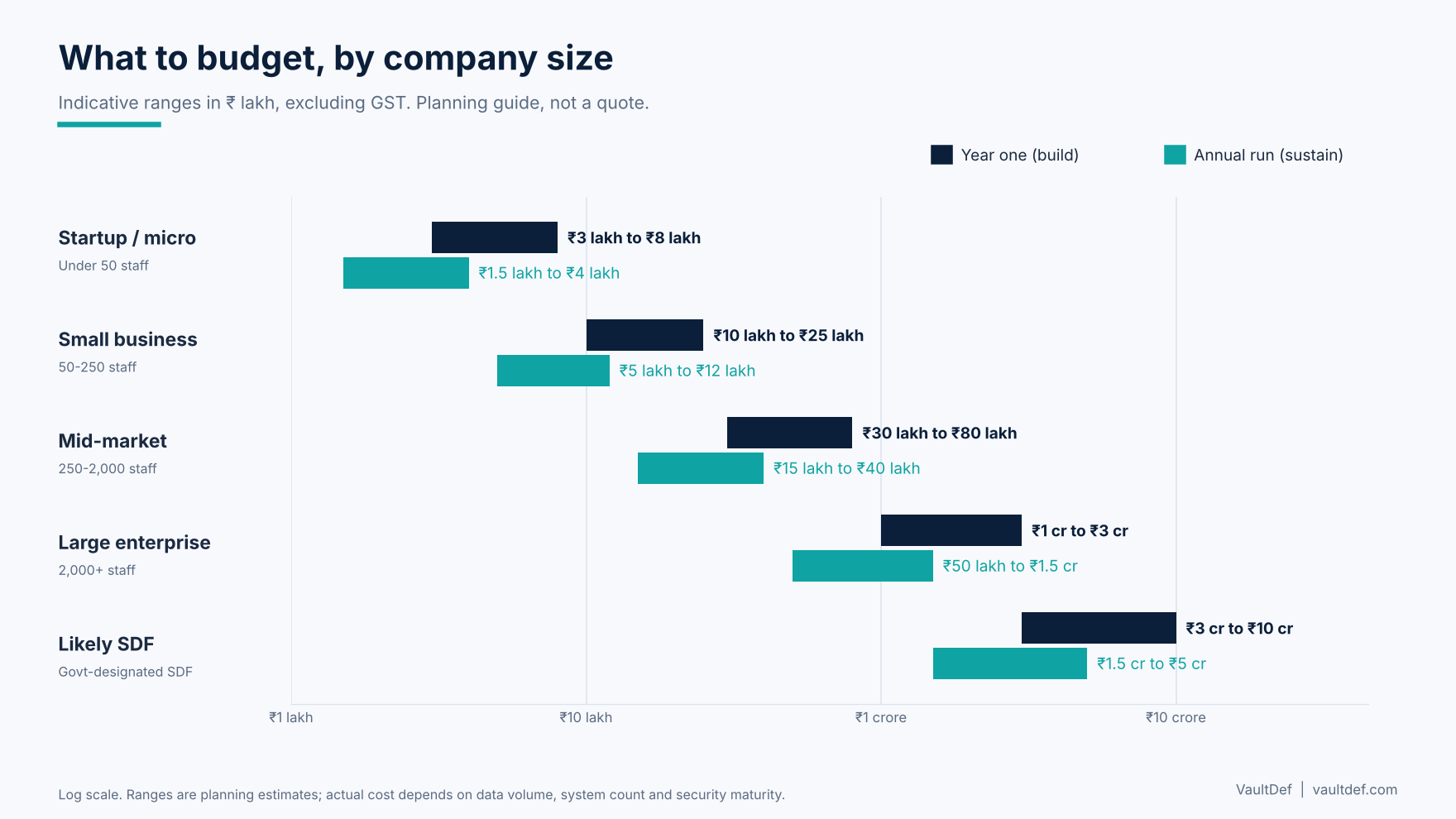
Here is the central view. "Year one" covers building the programme. "Annual run" covers keeping it alive afterwards, which is where many budgets quietly fail.
| Tier | Typical profile | Year one | Annual run |
|---|---|---|---|
| Startup / micro | Under 50 staff, one product, a few lakh Data Principals at most | ₹3–8 lakh | ₹1.5–4 lakh |
| Small business | 50–250 staff, 3–10 systems | ₹10–25 lakh | ₹5–12 lakh |
| Mid-market | 250–2,000 staff, 15–50 systems, vendor-heavy | ₹30–80 lakh | ₹15–40 lakh |
| Large enterprise | 2,000+ staff, 50+ systems, multiple entities | ₹1–3 crore | ₹50 lakh–1.5 crore |
| Likely Significant Data Fiduciary | Very large data volumes or sensitive categories | ₹3–10 crore | ₹1.5–5 crore |
Startups and micro businesses
Your cost is low because your estate is small, but your margin for error is smaller still. A disciplined spreadsheet RoPA, a rewritten notice and consent flow, a handful of vendor addenda and one tabletop exercise will carry most of the load. The biggest line is usually advisory time, not software. Spend where you collect data, which is your signup and checkout, not on a policy PDF.
Small businesses
This is the tier where the spreadsheet starts to creak. Once HR, sales and support each hold their own lists, you need a named owner and some tooling for consent records and rights requests. The classic trap here is assuming the IT manager can absorb it alongside a full-time job. They cannot, and the cost shows up later as an unanswered customer request.
Mid-market
Vendor management becomes the hidden centre of gravity. Between your payroll provider, cloud CRM, marketing agency, call centre and logistics partners, you may have thirty processors, and each one is your accountability. Expect a dedicated privacy lead, meaningful tooling spend, and a real security uplift to meet Rule 6. This tier also faces the most customer-driven pressure, because enterprise buyers now send DPDP questionnaires down their supply chain.
Large enterprises
Complexity, not volume, drives the number. Multiple legal entities, legacy systems with no deletion capability, and overlapping sector rules from RBI, IRDAI, SEBI or CERT-In all multiply the effort. A central privacy office with business-unit champions is the practical model.
Likely Significant Data Fiduciaries
The Central Government can designate Significant Data Fiduciaries based on volume and sensitivity of data, risk to Data Principals, and risks to the State and public order. If designated, you must appoint an India-based Data Protection Officer, engage an independent data auditor, and carry out periodic DPIAs. Rule 13 adds a requirement to verify that algorithmic software does not pose risk to Data Principals' rights. These roles, independent audits and DPIA cycles are why this tier has its own budget band.
Where the money actually goes
For a typical mid-market company, the Year one spend splits roughly as the chart below shows. The ranges in the table reflect how the split shifts with size and maturity.
| Cost bucket | Typical share of Year one | Biggest cost driver |
|---|---|---|
| Data discovery and RoPA | 20–25% | Number of systems and shadow data |
| Legal and policy | 15–20% | Number of collection points, vendors and languages |
| Technology | 20–30% | Volume of Data Principals and integrations |
| Security uplift | 10–25% | Your starting security maturity |
| People | 10–20% | Whether you hire, or divert existing staff |
| Training and rehearsal | 5–8% | Headcount and number of roles |
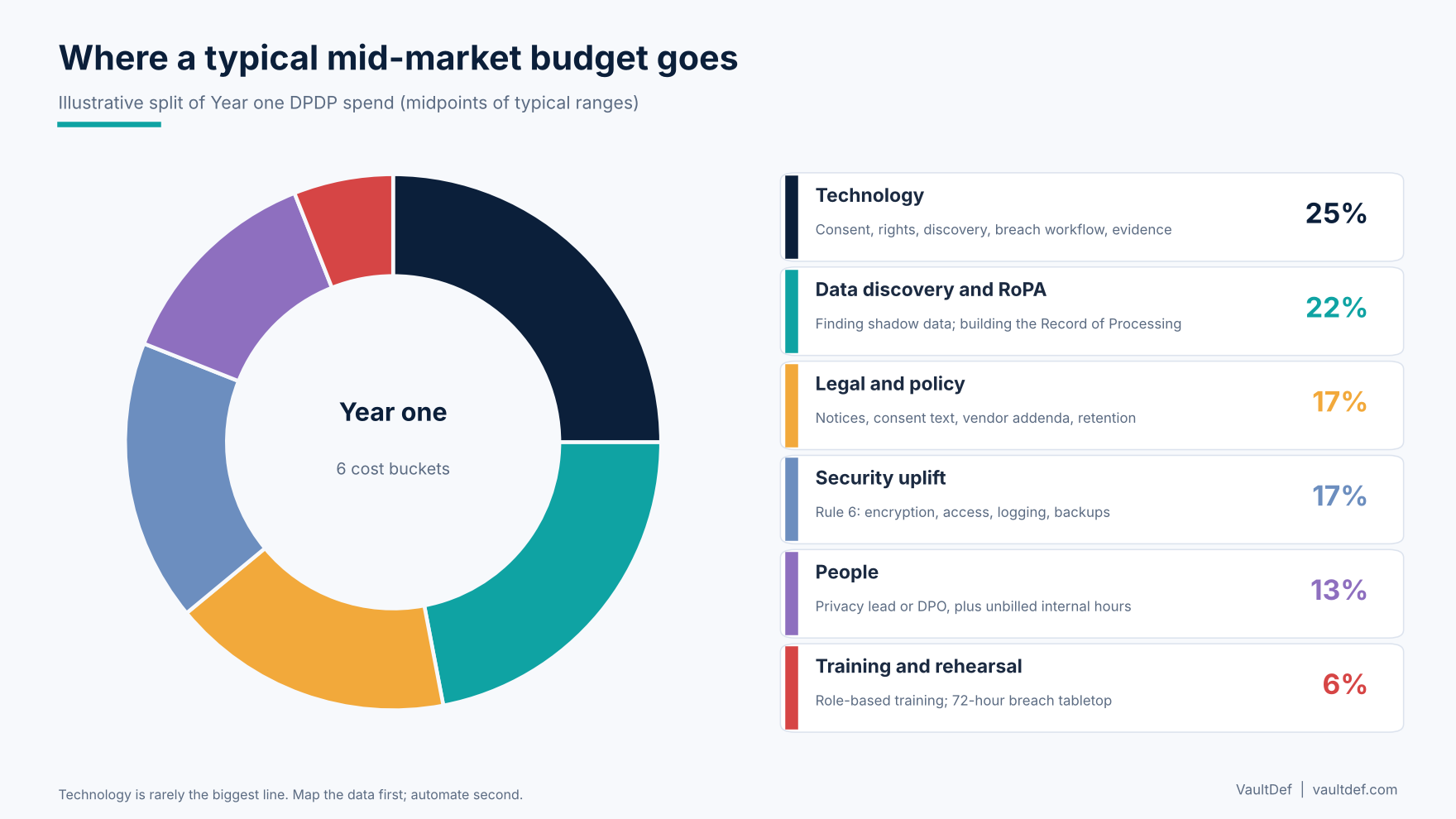
Notice that technology is not the largest line in every case. Organisations that buy tooling first routinely overspend, because they automate a process they have not yet understood. Discovery and ownership come first. Tooling then makes the result repeatable.
The challenges nobody puts in the budget
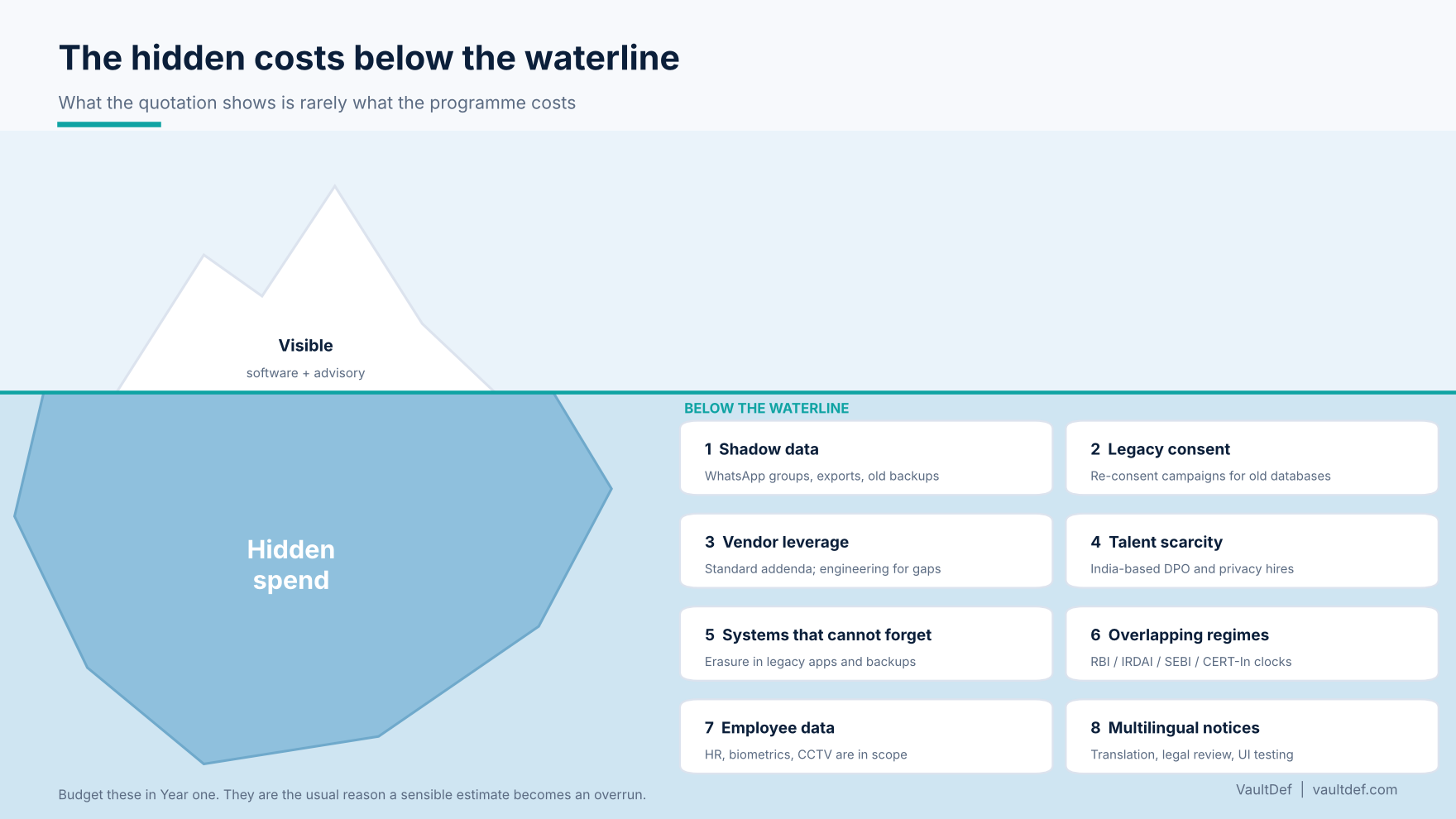
These are the items that turn a sensible estimate into an overrun. Each is real, and each appears again and again in Indian organisations.
1. Shadow data. The ERP is documented. The Chennai branch's WhatsApp group with four thousand customer numbers is not. Exported spreadsheets, old backups, biometric machines and agency-bought marketing lists all count as personal data in digital form. Finding them takes weeks, and the effort scales with how informally the business has grown.
2. Legacy consent. A customer database built over eight years under old assumptions needs fresh notice and, often, fresh consent. Re-consent campaigns cost real money in messaging, design and lost reach, and they need to be planned, not improvised.
3. Limited leverage over big vendors. A mid-sized company asking a global SaaS provider for custom data protection terms will usually get the standard addendum. Your budget must cover legal review of what they give you, and engineering effort for the gaps you cannot negotiate away.
4. Talent scarcity. Experienced privacy professionals are in short supply in India, and an India-based DPO for a Significant Data Fiduciary is a specific hire. Salary expectations in this niche have moved faster than the general market.
5. Systems that cannot forget. Erasure is a legal duty once purpose ends, but many legacy systems and backups were never designed to delete a single person's record. Fixing this can mean engineering work far beyond the compliance team.
6. Overlapping regimes. A bank or insurer already answers to sector regulators. CERT-In's incident reporting window is far shorter than the DPDP breach report window, so your response plan must satisfy both clocks at once, and your evidence must serve multiple auditors.
7. Employee data. Many organisations treat HR records, biometric attendance and CCTV footage as internal and therefore out of scope. They are not. Employees, applicants and visitors are all Data Principals.
8. Multilingual notices. The Rules expect notices a normal person can understand, and for many consumer businesses that means more than English and Hindi. Translation, legal review and interface testing in several languages add up quickly.
What non-compliance puts on the other side of the ledger
Budgeting is easier when you know the exposure. These are the maximum penalties the Act's Schedule sets out, which the Data Protection Board can impose.
| Violation | Maximum penalty |
|---|---|
| Failure to take reasonable security safeguards | Up to ₹250 crore |
| Failure to notify the Board and affected individuals of a breach | Up to ₹200 crore |
| Breach of children's data obligations | Up to ₹200 crore |
| Breach of additional Significant Data Fiduciary obligations | Up to ₹150 crore |
| Breach of any other provision of the Act or Rules | Up to ₹50 crore |
| Breach of duties by a Data Principal | Up to ₹10,000 |
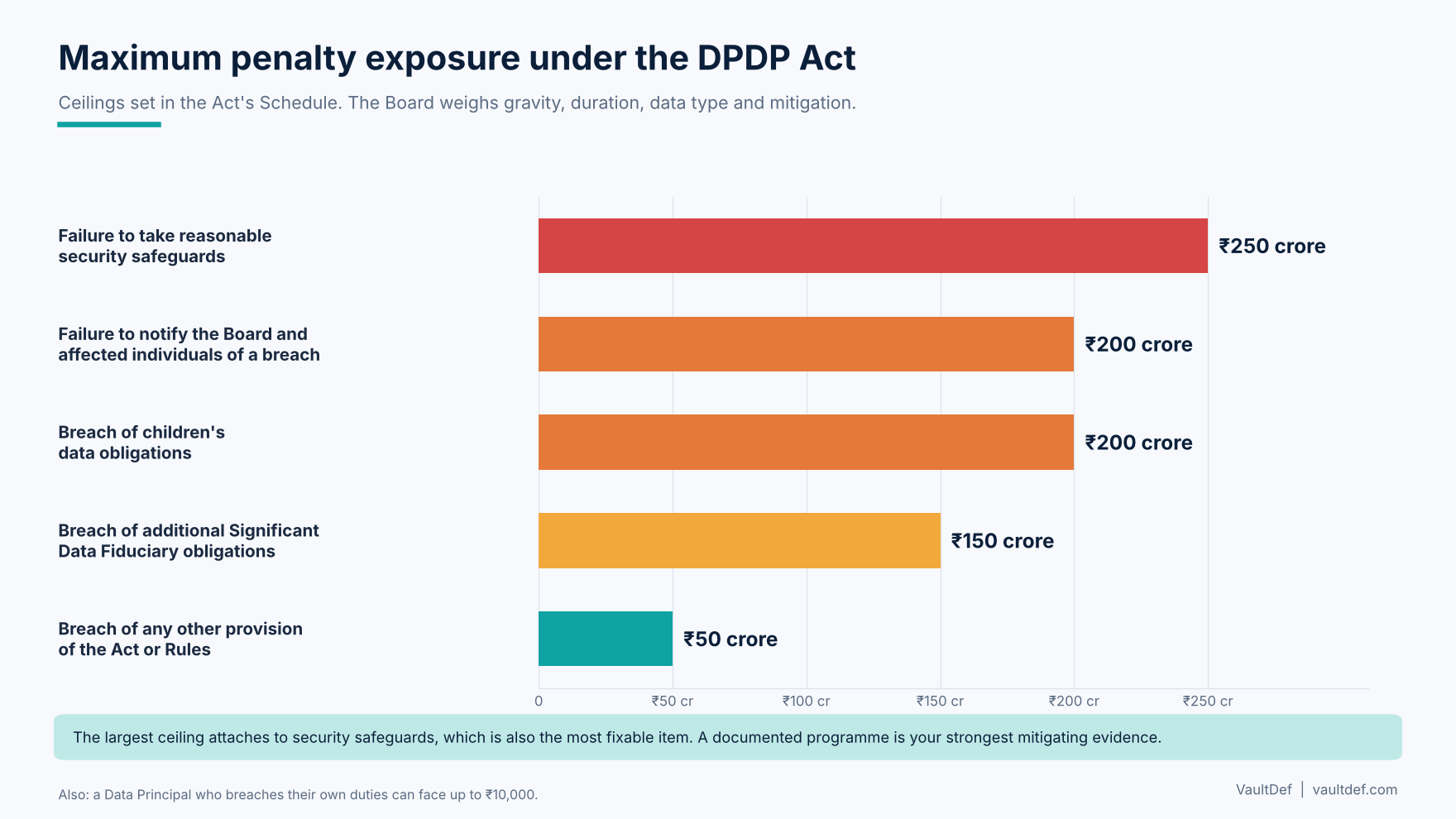
Two cautions keep this in proportion. First, these are ceilings, not predictions. Under Section 33, the Board considers the nature, gravity and duration of the breach, the type of data, and the steps taken to mitigate harm. Second, the largest figure attaches to security safeguards, which is also the most fixable item. A documented programme is your strongest mitigating evidence.
Five budgeting mistakes we see repeatedly
- Budgeting for Year one only. The annual run is typically half of Year one or more. A programme with no run budget decays within two quarters.
- Buying the platform before mapping the data. You end up with excellent monitoring of the wrong corridor.
- Forgetting internal hours. Several hundred hours across IT, HR, Marketing and Procurement are real cost, even though they never reach Finance as an invoice.
- Treating legal review as a one-off. Every new vendor, campaign and system reopens it.
- Starting late. Discovery, re-consent and vendor remediation have long lead times. Compressing them into the final quarter costs a premium.
How to phase the spend
Spreading the budget across three phases keeps cash flow sane and sequences the work correctly.
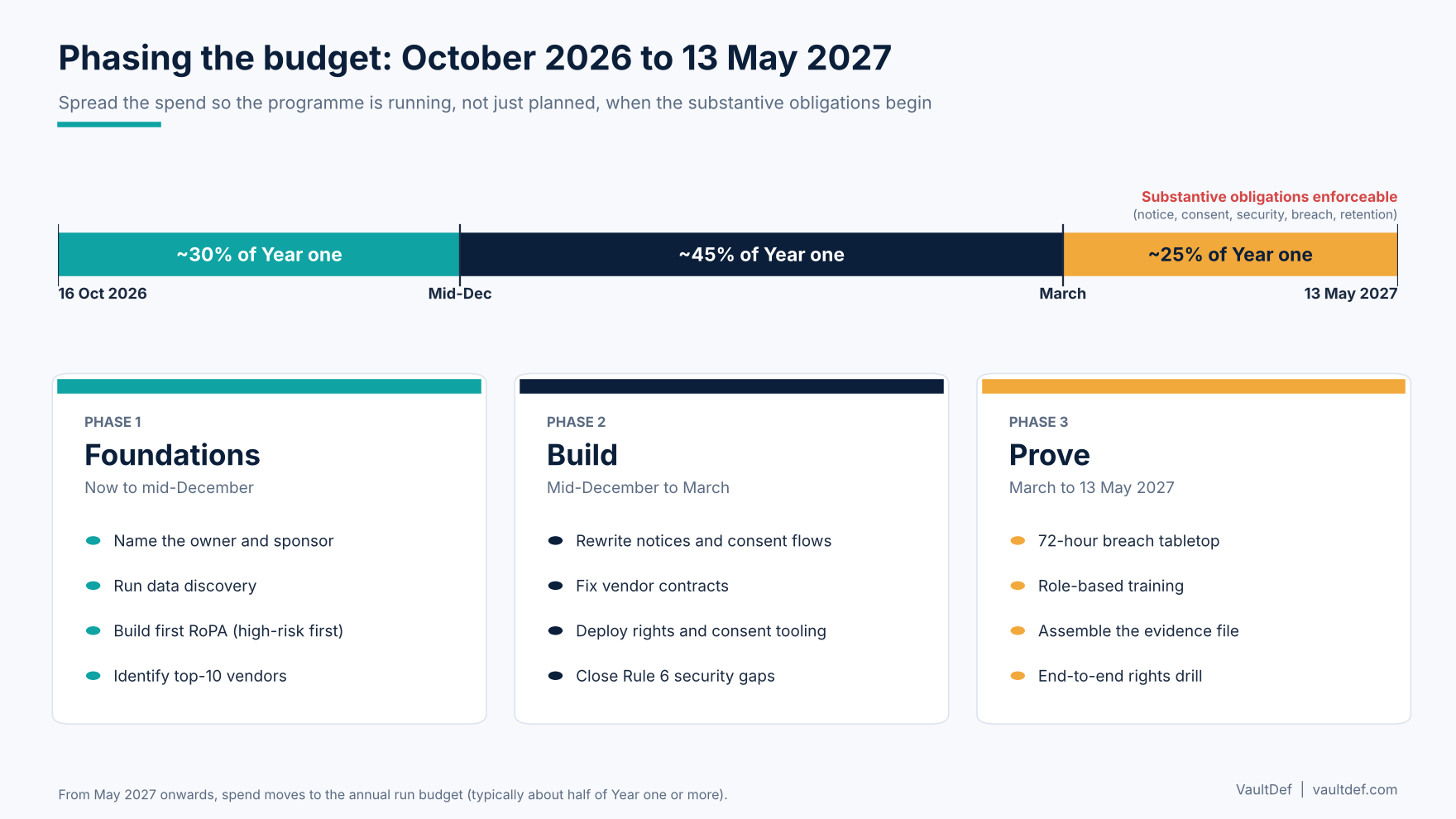
Phase 1, now to mid-December: foundations (about 30% of Year one). Appoint the owner, run discovery, and build the first RoPA for your highest-risk processing. This is cheap relative to its value, because everything else depends on it.
Phase 2, mid-December to March: build (about 45%). Rewrite notices and consent flows, remediate vendor contracts, deploy rights and consent tooling, and close the Rule 6 security gaps.
Phase 3, March to 13 May 2027: prove (about 25%). Run the breach tabletop, train by role, assemble the evidence file, and rehearse a rights request end to end. From May onwards you are into the annual run budget.
How VaultDef can help
You can run DPDP on disciplined spreadsheets at the small end, and you should. But as your estate grows, the cost curve in this article starts to bend upward, and most of the bend comes from manual work: finding data, tracking consent, chasing vendors, and assembling evidence for each audit.
VaultDef is built by practitioners who have worked across offensive security, defensive security and compliance, including RBI and CERT-In regimes for banks, NBFCs, insurers and fintechs. It targets exactly the cost buckets above:
| Cost bucket | Where VaultDef fits |
|---|---|
| Data discovery and RoPA | Automated data discovery and classification, with RoPA and data mapping |
| Legal and policy | Consent and notice management, with vendor and cross-border tracking |
| Technology | One platform for rights requests, cookie consent and breach workflow |
| Security and breach readiness | Breach workflow and detection support aligned to the 72-hour report |
| Audit and DPIA | DPIA support and a tamper-evident evidence trail |
The point is not that software replaces ownership, policy or judgement. It does not. The point is that it turns the recurring work, which is the part that quietly dominates your annual run budget, into something repeatable that produces dated evidence as a by-product.
If you want to test this against your own numbers, a VaultDef working demo connects to a sample of your schema and produces a gap assessment during the session. Bring your tier from the table above, and we will show you which cost lines it moves.
The honest closing thought
Compliance cost is not a mystery. It is the price of knowing what you hold, keeping promises to the people it belongs to, and writing it down as you go. The organisations that overspend are rarely the ones with small budgets. They are the ones that started late, bought before they mapped, and treated the first year as the whole bill.
Take the table in this article to your CFO this week. Agree a Year one number, an annual run number, and a start date. Then start with discovery.
Frequently asked questions
Does DPDP apply to small companies and startups?
Yes. The Act has no turnover or headcount threshold. The Government may relax certain obligations for startups under Section 17(3), so verify current notifications before assuming relief.
What is the biggest single cost driver?
The number of systems and vendors that touch personal data. More systems mean more discovery, more contracts and more security work.
Do we need a Data Protection Officer?
An India-based DPO is mandatory only for Significant Data Fiduciaries. Every other organisation should still appoint an accountable privacy lead and publish a grievance contact.
Are these figures official?
No. They are indicative planning ranges, not statutory figures or quotes. Your actual cost depends on data volume, system count and security maturity.