Preparing for DPDP Audits in 2026: A Practical Readiness Checklist Every Indian Organisation Should Follow
The first DPDP question most Indian companies face does not come from a regulator. It comes from a customer.
It usually looks like this. A Thursday evening email lands in the inbox of an auto-components supplier in Pune. It is a vendor renewal questionnaire from their largest OEM buyer. Question 14 reads: “Describe your organization's readiness under the Digital Personal Data Protection Act, 2023 and the DPDP Rules, 2025. Attach evidence.” Response due Monday.
The CIO forwards it to Legal. Legal forwards it back to the CIO. Neither has read the Act. Both assume the other owns it.
If that scene feels uncomfortably familiar, this article is for you. You do not need a law degree to get through it, and you do not need to have read a single section of the DPDP Act to start. By the end you will know what a DPDP audit actually is, who in your company should be doing this work, whether it is a software problem or a process problem, whether it ever ends, and exactly what to do first.
Let us start by removing the fear, because most of it is misplaced.
Nobody is asking you to become a privacy lawyer
Strip away the legal language and India's data protection law rests on one simple idea: if you hold personal information about a living person, you are holding something that belongs to them, and you owe them care in how you use it.
Four words will carry you through ninety percent of every DPDP conversation you will ever have.
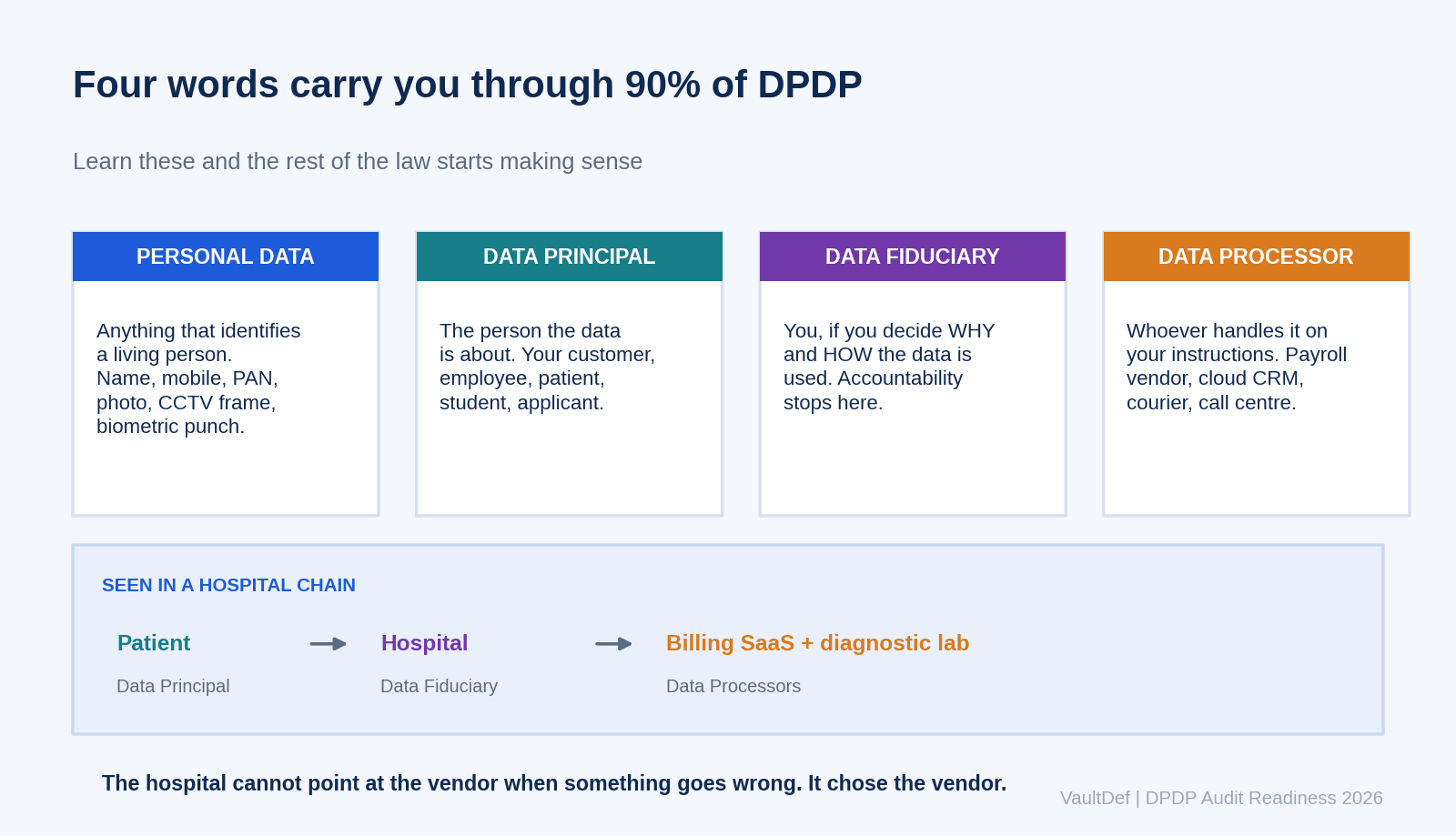
Read those four again. That is the foundation. Everything else in DPDP is detail built on top of it. Note that the law covers personal data in digital form, including paper records you later digitise. That last part catches more companies than they expect. The visitor register at your reception is out of scope until someone scans it.
A hospital chain in Hyderabad makes the point cleanly. The patient is the Data Principal. The hospital is the Data Fiduciary. The billing software vendor and the diagnostic lab are Data Processors. The hospital cannot point at the vendor when something goes wrong. It signed the contract, it chose the vendor, it owns the outcome.
Why 2026 turned into the year everyone started asking
For two years after the DPDP Act received assent in 2023, nothing much happened. Companies filed it under “later.” Then the DPDP Rules, 2025 were notified on 13 November 2025, and “later” acquired dates.
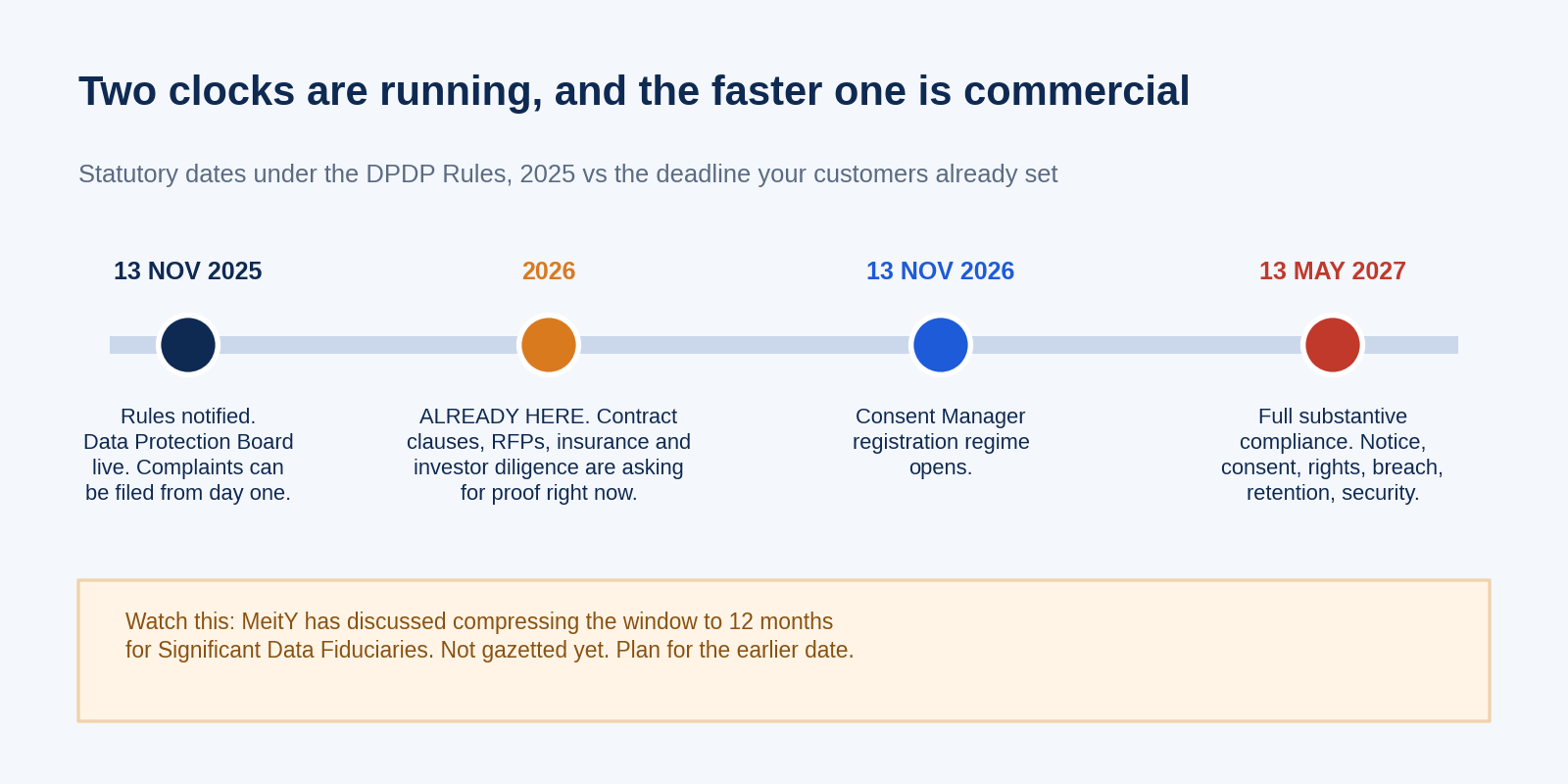
| Date | What changes | What you should already have done |
|---|---|---|
| 13 Nov 2025 | DPDP Rules notified. Data Protection Board constituted and functioning. | Decided whether you are a Data Fiduciary, and whether you may be designated a Significant Data Fiduciary. |
| Through 2026 | No statutory deadline, but customers, banks, insurers and investors begin demanding proof in contracts and questionnaires. | Be able to answer a DPDP due-diligence questionnaire without a fire drill. |
| 13 Nov 2026 | Consent Manager registration regime opens. | Decided whether a Consent Manager is relevant to your business model. |
| 13 May 2027 | Full substantive compliance. Notice, consent, data principal rights, security safeguards, breach reporting, retention and erasure, children's data, cross-border conditions. | Everything in the ten-step checklist below, running as business-as-usual rather than as a project. |
There is a live proposal from MeitY, discussed with industry in January 2026, to compress the window for Significant Data Fiduciaries from eighteen months to twelve. It has not been gazetted at the time of writing. Treat it as a reason to move earlier, not as a reason to wait and watch.
But the statutory calendar is the slower of the two clocks running. The faster one is commercial, and it has already gone off. DPDP clauses are now standard in enterprise contracts, in bank RFPs, in PSU tenders, in cyber-insurance proposals, and in every investor due-diligence checklist. A logistics firm that cannot answer a DPDP questionnaire in 2026 loses the contract in 2026, regardless of what 2027 holds.
So what exactly is a “DPDP audit”?
The phrase gets used loosely, and the confusion causes real problems. There are three distinct things people mean, and you should prepare for all three because they ask the same underlying question.
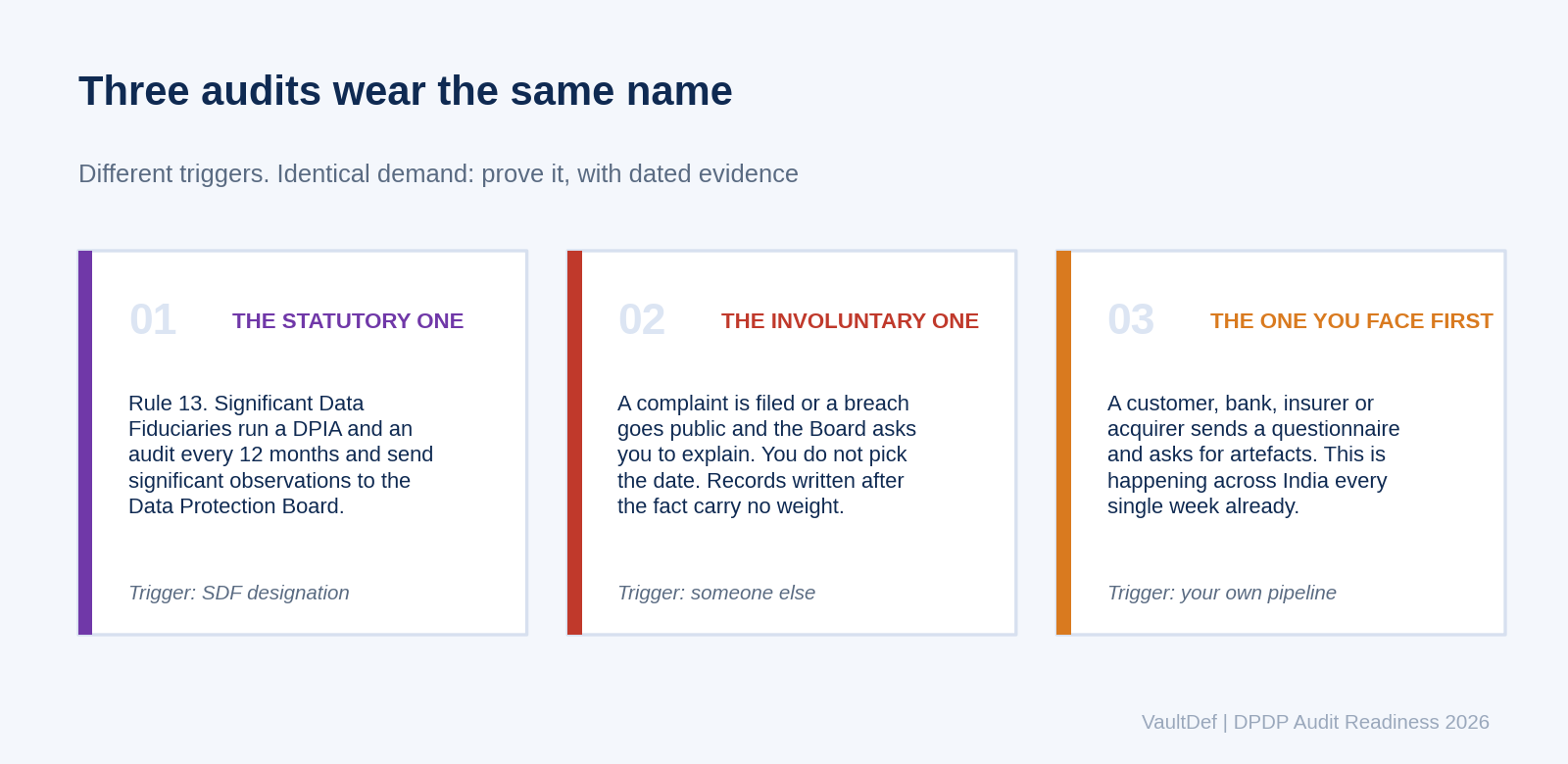
Three different triggers, one identical demand: prove it. Not “describe your intentions.” Prove it, with documents that carry dates.
That single word is the whole point of readiness work. Everything below exists to make sure that when someone says “prove it,” you can open a folder rather than open a war room.
What the law actually puts at stake
It is worth seeing the numbers once, then putting them away. Fear is a poor project manager, but scale is useful context when you are asking a board for budget.
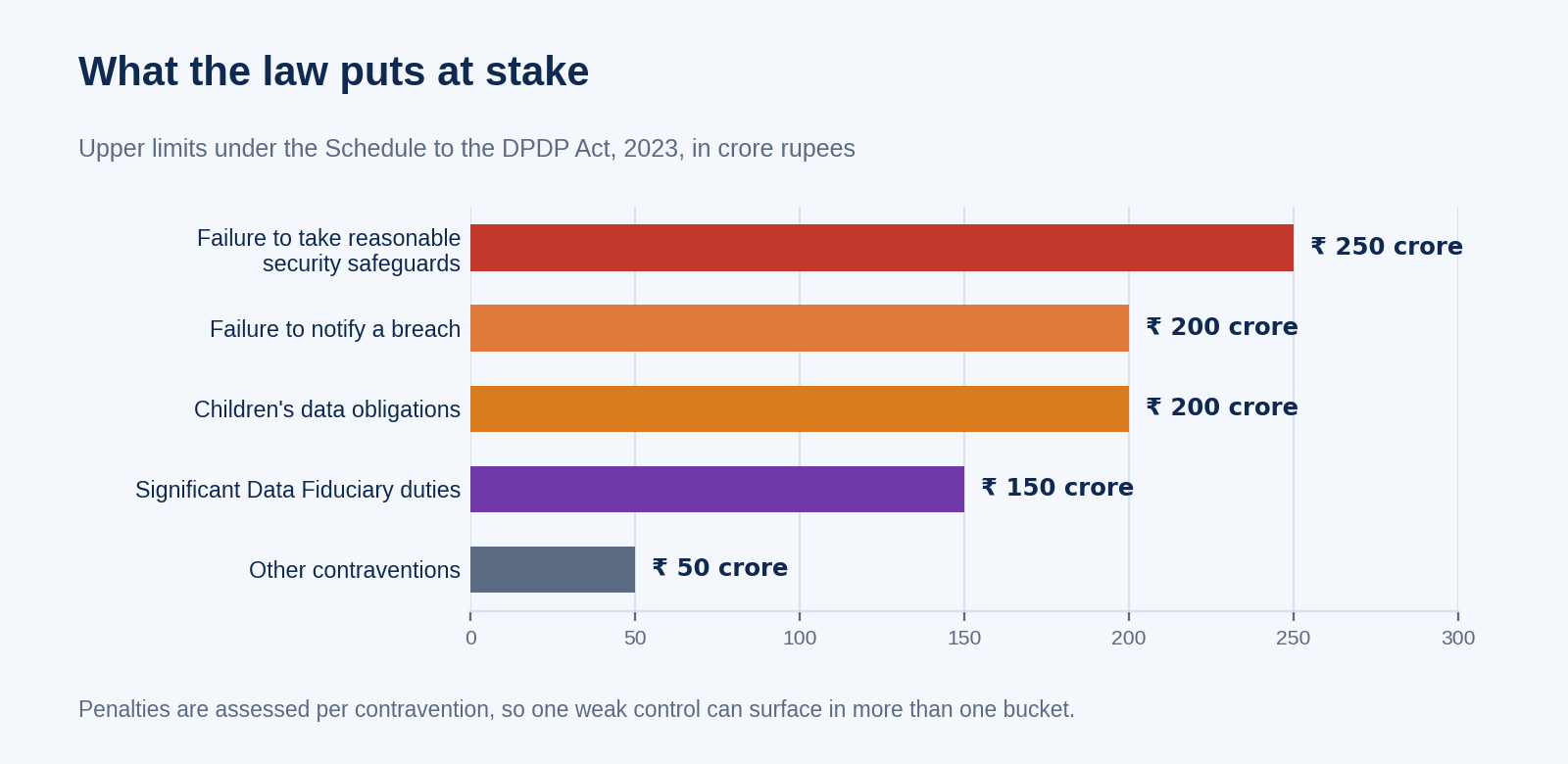
Look at the shape of it rather than the size. The largest exposure sits on security safeguards, which happens to be the most fixable item on the entire list, and the one your existing IT team is already half-way through. That should be encouraging rather than alarming.
The skill you actually need is curiosity, not case law
Here is the part nobody tells you, and it is the most encouraging thing in this article.
The hardest parts of DPDP implementation are not legal. They are organizational.
The genuinely difficult question is not “what does the law require.” It is “does anyone here know why the Chennai branch keeps a WhatsApp group with 4,000 customer numbers in it, and for how long?” No consultant can answer that. Only your own people can.
Which means the person who leads this work does not need fifteen years in privacy law. They need five things, and all five are learnable:
● A working understanding of what personal data is and why it matters. A weekend of reading gets you there.
● The patience to ask “why do we collect this, and what do we do with it?” repeatedly, without accepting “we've always done it that way.”
● Enough credibility inside the company to get straight answers out of HR, Marketing and Sales.
● A habit of writing things down in a form someone else can read six months later.
● The discipline to revisit it every quarter.
That profile exists in almost every organisation. It is often a senior IT manager, a compliance officer, a company secretary, an operations head, or a sharp business analyst. It is very rarely the person with the most impressive certificate.
You will want specialist help at the edges. Complex cross-border structures, sectoral overlaps with RBI or IRDAI or CERT-In directions, a Significant Data Fiduciary audit, a DPIA methodology, a live breach. Bring experts in for those. But the mapping, the ownership and the daily discipline are yours.
One practical note. Put the right people in the room from day one: IT, HR, Marketing, Sales, Customer Support, Finance, Procurement, Legal, and one executive sponsor with the authority to settle arguments. Every one of those functions is holding personal data. Marketing usually turns out to be holding the most, in the most places, with the least documentation.
Is this a tool problem or a process problem?
Both. In that order.
Buying privacy software before you understand your data is like installing a CCTV system before you have counted the doors in the building. You will get very good footage of the wrong corridor.
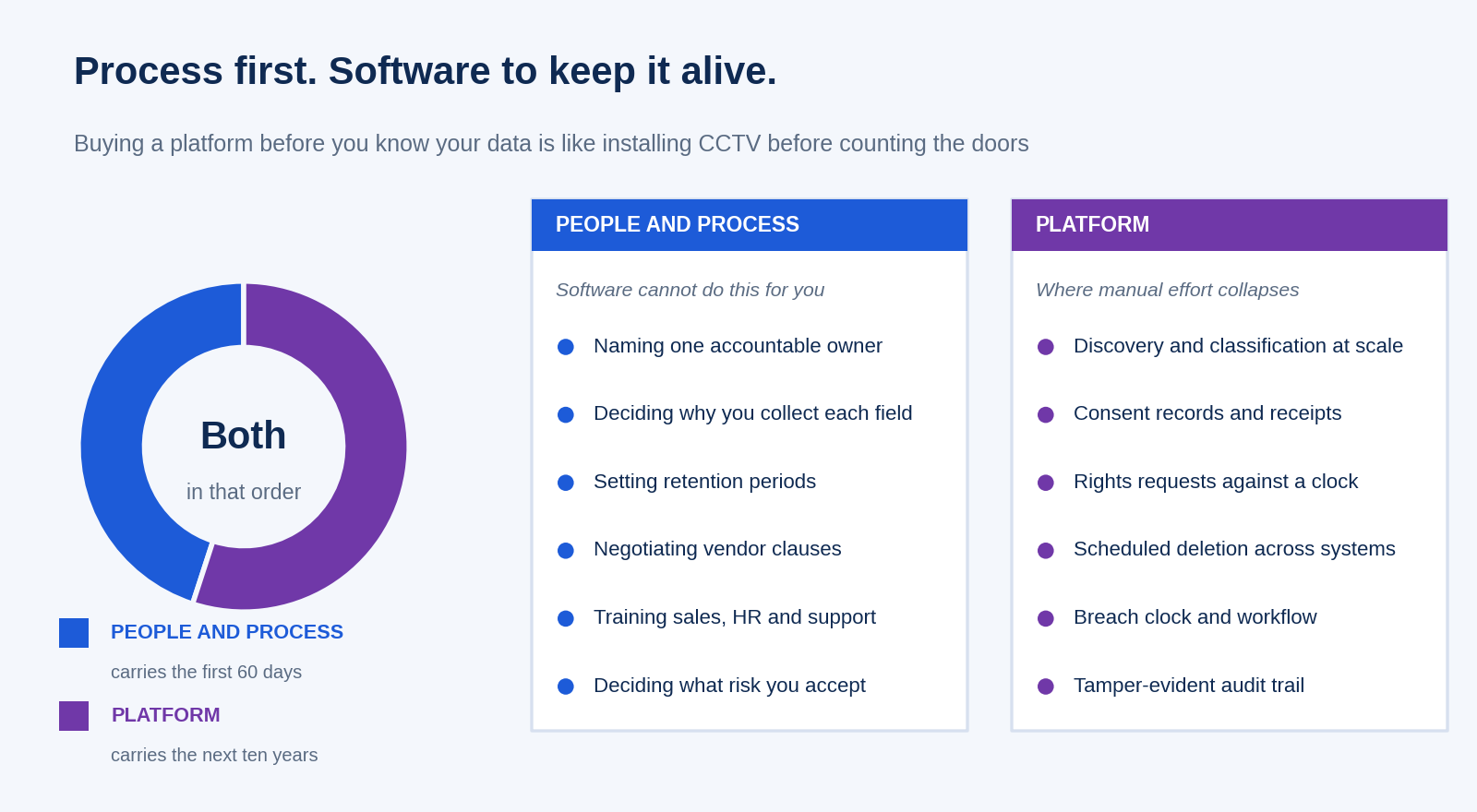
A ten-person consultancy can run DPDP on disciplined spreadsheets. A bank with eleven million customers, sixty applications and forty vendors cannot. Be honest about which one you are, and remember that you can start with process this quarter and add tooling next quarter without wasting the first quarter's work.
The most expensive myth: “we'll do it once and be done”
This one deserves its own section, because a surprising number of experienced people still believe it. DPDP compliance is not a project with a completion date. It is not a certificate you frame and hang in reception. It behaves much more like your books of accounts: maintained continuously, reviewed periodically, and inspected at moments you do not choose.
Consider a mid-sized e-commerce company that does everything right in March. Full data map, clean consent flow, signed vendor agreements, published grievance contact. Excellent work.
By September, Marketing has adopted two new analytics tools and a WhatsApp engagement bot. Operations has onboarded a third courier partner in Tier-2 cities. HR has switched applicant tracking systems. A developer spun up a staging database with a copy of production data in it for testing. The consent notice from March does not cover the new purposes. Three of the new data flows are undocumented. The data map is now fiction.
Nothing went wrong. The business simply operated.
| Activity | Real frequency | What triggers it in between |
|---|---|---|
| Data inventory and RoPA refresh | Quarterly | Any new system, vendor, app or integration goes live |
| Notice and consent review | Twice a year | A new purpose, a new channel, a new campaign type |
| Data principal rights handling | Daily, on demand | Any request from any customer or ex-employee |
| Retention and deletion runs | Monthly or automated | A retention period expires |
| Vendor and processor review | Annual, plus at onboarding | New vendor, renewal, or a vendor's own breach |
| Access review and security testing | Quarterly | Role changes, exits, new infrastructure |
| Breach drill | Annual at minimum | Any near-miss or real incident |
| DPIA and audit (Significant Data Fiduciaries) | Every 12 months | A new high-risk processing activity |
A DPDP audit does not examine one day. It examines a trail of dated evidence across the year. You cannot manufacture that trail retrospectively, and any auditor worth hiring will notice if you try. Once you accept that this is a habit rather than an event, the workload actually gets smaller. The first cycle is heavy. The fourth is routine.
The DPDP readiness checklist: ten steps, in order
Now we get to the practical part. Work through these in sequence. Each step produces something you can hand to an auditor, a customer, or your own board.
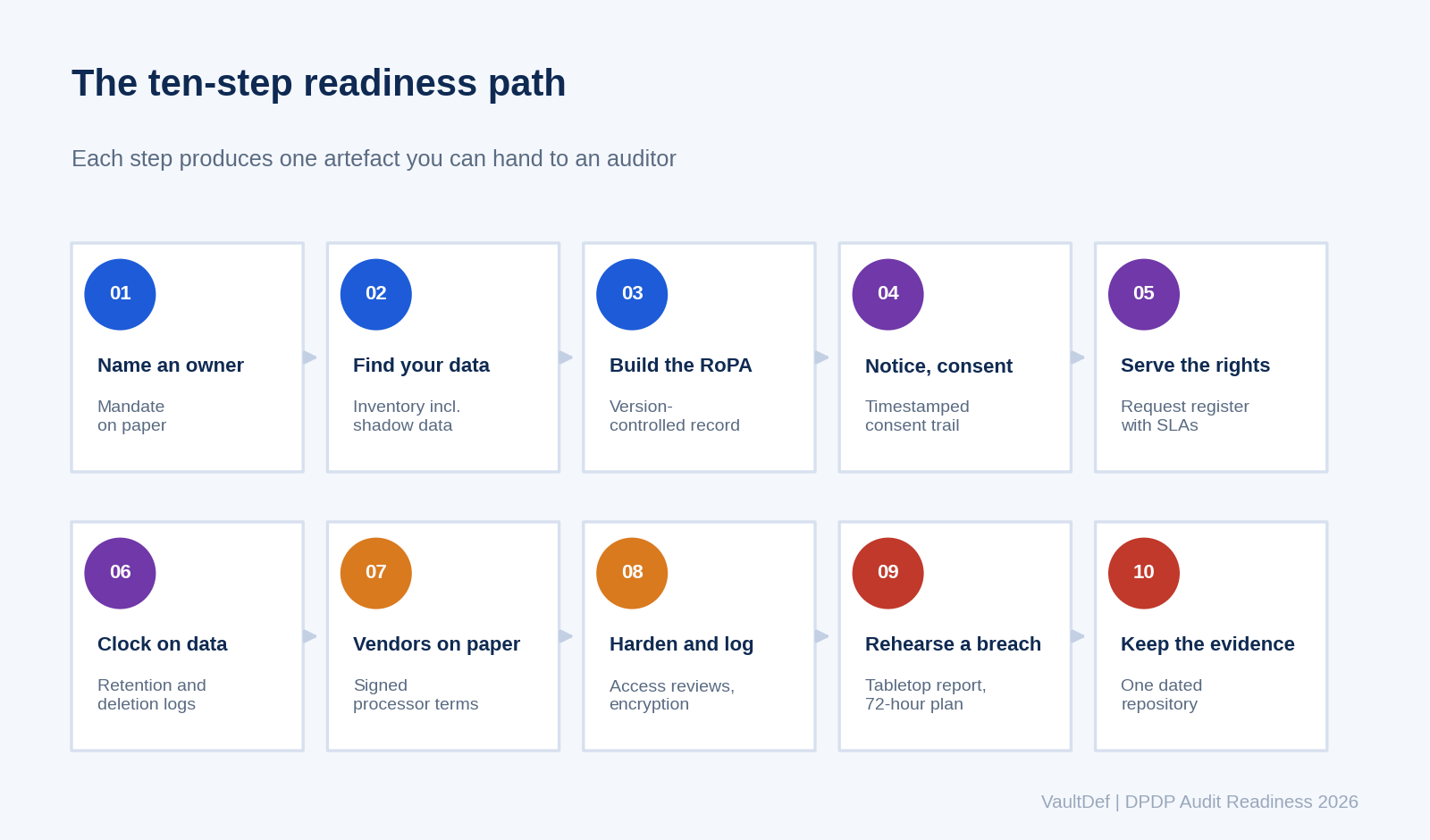
Step 1: Name an owner and give them real authority
One named person, accountable, with a written mandate and an executive sponsor. Not a committee. Committees distribute responsibility until none of it lands anywhere.
If you expect to be designated a Significant Data Fiduciary, you will need a Data Protection Officer based in India. Everyone else should still appoint an internal privacy lead, publish their contact details, and put a small cross-functional working group around them.
Evidence produced: appointment note, scope document, published grievance contact.
Step 2: Find your data before someone else finds it for you
This is the step that determines whether the other nine are real or decorative.
Inventory every place personal data lives. Core applications first: ERP, CRM, HRMS, billing, ticketing, the website. Then go hunting for shadow data, which is where the unpleasant surprises hide. Exported spreadsheets on laptops. Email attachments. WhatsApp groups. Shared drives with folders named customer_data_final_v3. Old backups nobody has restored since 2021. Biometric attendance machines. CCTV recorders. Marketing lists bought from an agency four years ago.
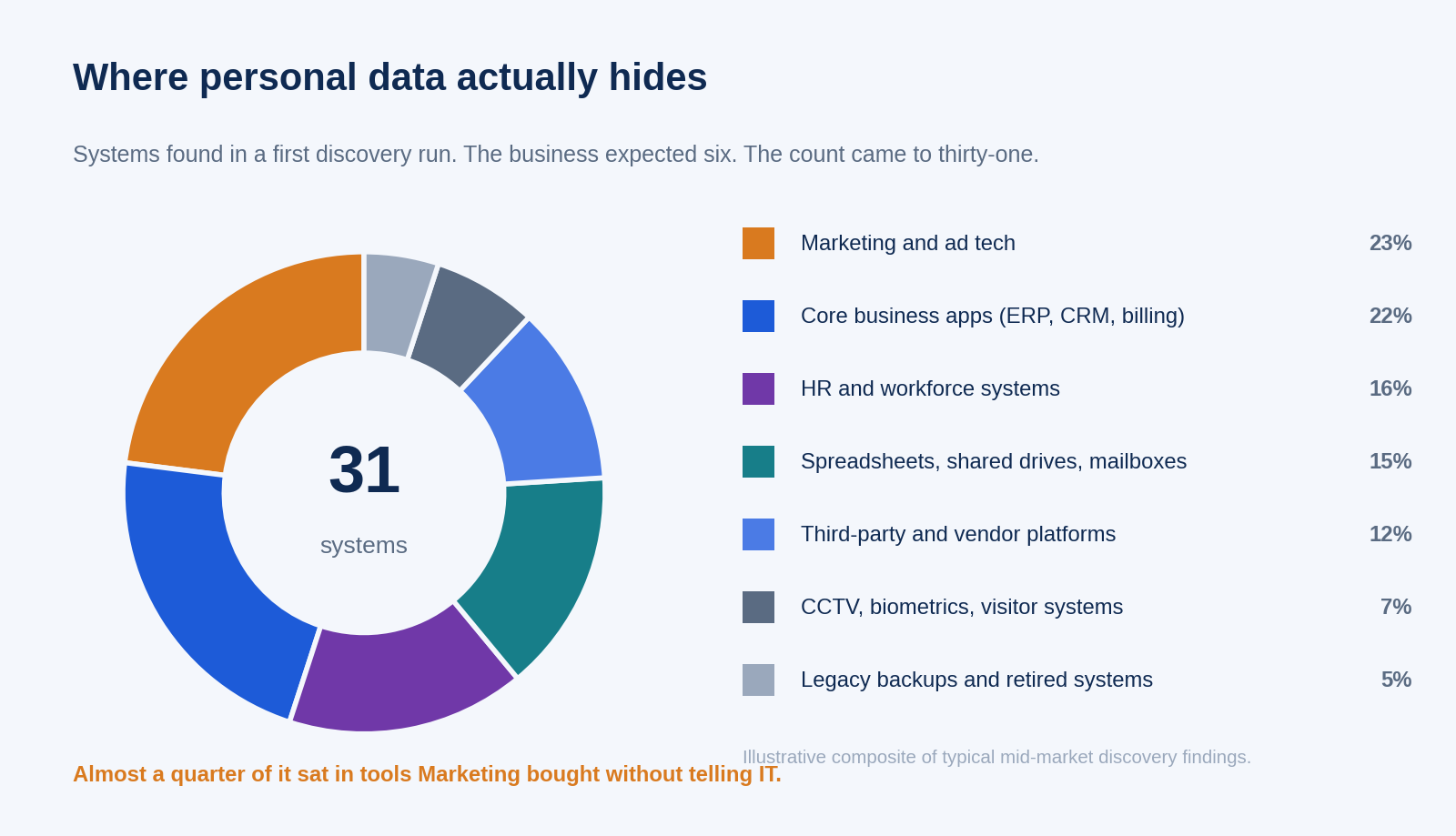
Evidence produced: a data inventory with a named owner against every system.
Step 3: Build a record of processing you would be willing to show
Your Record of Processing Activities, or RoPA, is the spine of the whole programme. For each activity, record what you collect, from whom, why, on what basis, where it sits, who can see it, who you share it with, whether it leaves India, and how long you keep it.
| Column | What it means | Worked example: a D2C brand's delivery flow |
|---|---|---|
| Processing activity | The business purpose, in business language | Order fulfilment and delivery |
| Data categories | The actual fields | Name, mobile, address, pincode, order history |
| Data principals | Whose data it is | Customers who placed an order |
| Purpose | Why you need each field | Route the shipment and confirm delivery |
| Basis | Consent, or a legitimate use under the | Act Consent captured at checkout |
| Storage | System and location | Shopify store plus warehouse management system |
| Access | Who can see it internally | Ops team and two support agents |
| Shared with | Processors and recipients | Courier partner, SMS gateway |
| Crosses border? | Yes or no, and to where | Yes, SaaS hosted in Singapore |
| Retention | How long, and why that long | 24 months for returns and warranty claim |
Perfection on activity one beats a half-finished list of eighty. Rank by volume and sensitivity, and work downwards.
Evidence produced: the RoPA itself, version-controlled and dated.
Step 4: Fix consent and notice where the data enters
Every point of collection needs a notice a normal person can understand: what you are collecting, why, how they withdraw, and how they complain. Plain language, available in India's scheduled languages, standalone rather than buried on page nine of your terms.
Consent itself must be freely given, specific, informed and unambiguous, through a clear affirmative action. Which rules out three very common practices: pre-ticked boxes, bundling marketing consent into the service agreement, and the classic “by continuing to use this site you agree to everything.”
Withdrawal must be as easy as giving. If signing up takes one click and unsubscribing takes an email to a mailbox nobody monitors, you have a finding waiting to happen. And do not forget the data you already hold: a customer database built over eight years under old assumptions needs fresh notice, not hopeful silence.
Evidence produced: notice templates, consent records with timestamps, withdrawal logs.
Step 5: Make data principal rights boring
People can ask you for access to their data, correction of it, erasure of it, and they can nominate someone to act for them. They can complain, and you must give them a grievance mechanism before they escalate to the Board.
Build one intake channel. Ticket every request. Define an internal turnaround target and stay well inside the outer limits the Rules prescribe for grievance redressal. Test the process yourself by submitting a request as a customer and watching where it gets stuck. The worst outcome here is not a difficult request. It is a request that arrives and nobody notices for five weeks.
Evidence produced: request register with dates, response templates, SLA tracking.
Step 6: Put a clock on everything you keep
Delete is a feature, not a failure. Data you no longer hold cannot be breached, cannot be misused, and cannot appear in an audit finding.
Set a retention period for every category in your RoPA, tied to a business or legal reason you can articulate. Then actually delete. Certain classes of large e-commerce, gaming and social media intermediaries carry specific retention limits and advance-notice requirements before erasure, so check where you fall.
The candidate CV database from 2019 with eleven thousand resumes is the example every Indian HR team recognises. Ask why it still exists. There is usually no answer beyond inertia.
Evidence produced: retention schedule, deletion logs.
Step 7: Get your vendors on paper
Every processor handling personal data on your behalf needs a contract that addresses it. Rank your vendors by how much personal data they touch and start at the top: the payroll provider, the cloud CRM, the marketing agency, the call centre, the courier partner.
| Clause | Why it matters | Red flag in the contract you already signed |
|---|---|---|
| Purpose limitation | They use the data only for your instructions | Broad “for service improvement” language with no boundary |
| Security obligations | Their controls become your exposure | No specifics, only a promise of “industry standards” |
| Sub-processors | You cannot protect what you cannot see | Silence, or blanket permission to appoint anyone |
| Breach notification to you | Your own reporting clock depends on theirs | No timeline stated, or one longer than your own |
| Deletion or return at exit | Old vendors holding old data is a live risk | No exit obligation at all |
| Cross-border disclosure | You must know where the data physically sits | Location unspecified, or “global infrastructure” |
| Audit or evidence rights | You need proof, not assurances | No right to request any documentation |
Evidence produced: vendor register, signed data protection agreements, due-diligence records.
Step 8: Harden the basics, and keep the logs
The Rules expect reasonable security safeguards, and the largest penalty exposure under the Act attaches to failing to take them. In practice this means encryption at rest and in transit, masking or tokenization where appropriate, role-based access control with periodic review, logging and monitoring retained long enough to be useful in an investigation, backups you have actually tested restoring, and access revocation on the day someone leaves.
None of this is exotic. Most of it lives in your existing security programme. The DPDP-specific work is making sure it is applied to personal data specifically, and documented well enough to show someone.
Evidence produced: security policy, access review records, encryption inventory, log retention configuration.
Step 9: Rehearse the breach before you have one
When a personal data breach occurs, you must inform affected individuals without delay, inform the Board, and follow up with a detailed report to the Board within 72 hours.
SEVENTY-TWO HOURS IS NOT LONG
It includes the weekend. It includes the hours you spend arguing about whether it is really a breach. Run a tabletop exercise this quarter: pick a realistic scenario, such as a misconfigured cloud bucket exposing customer records, and walk through it. Who declares it. Who calls whom at 2 a.m. on a Sunday. Who drafts the notification. Who talks to the press. Who signs off. Write down the answers.
Teams that have rehearsed once behave completely differently from teams that have not. It is the single highest-return hour in this entire checklist.
Evidence produced: incident response plan, tabletop exercise report, breach register.
Step 10: Keep the evidence file as you go
Create one structured repository, dated and owned. An auditor does not grade your intentions. They sample your evidence. The organisation that assembles this folder continuously spends two days on an audit. The organization that assembles it the week before spends six weeks, and it shows.
| Step | Artefact in the evidence file | Usual owner |
|---|---|---|
| 01 | Appointment note, programme charter, committee minutes | Executive sponsor |
| 02 | Data inventory with system owners | IT |
| 03 | RoPA, version-controlled | Privacy lead |
| 04 | Notice templates, consent records, withdrawal logs | Product / Marketing |
| 05 | Rights request register with response times | Customer Support |
| 06 | Retention schedule and deletion logs | IT with business owners |
| 07 | Vendor register and signed data protection terms | Procurement / Legal |
| 08 | Security policy, access reviews, encryption inventory | Security |
| 09 | Incident response plan, tabletop report, breach register | Security / Privacy lead |
| 10 | Training attendance, quarterly review minutes | HR / Privacy lead |
Two habits that keep all of it alive
Train people in their own language of work. Not a generic slide deck. Show the sales team what they may and may not do with a lead list. Show HR what happens to a rejected candidate's file. Show support agents how to recognise a data principal request when it arrives phrased as an angry complaint.
Review quarterly, with an agenda. New systems, new vendors, new purposes, open requests, incidents, overdue deletions. Thirty minutes, four times a year, prevents the March-to-September drift described earlier.
If you only have ninety days
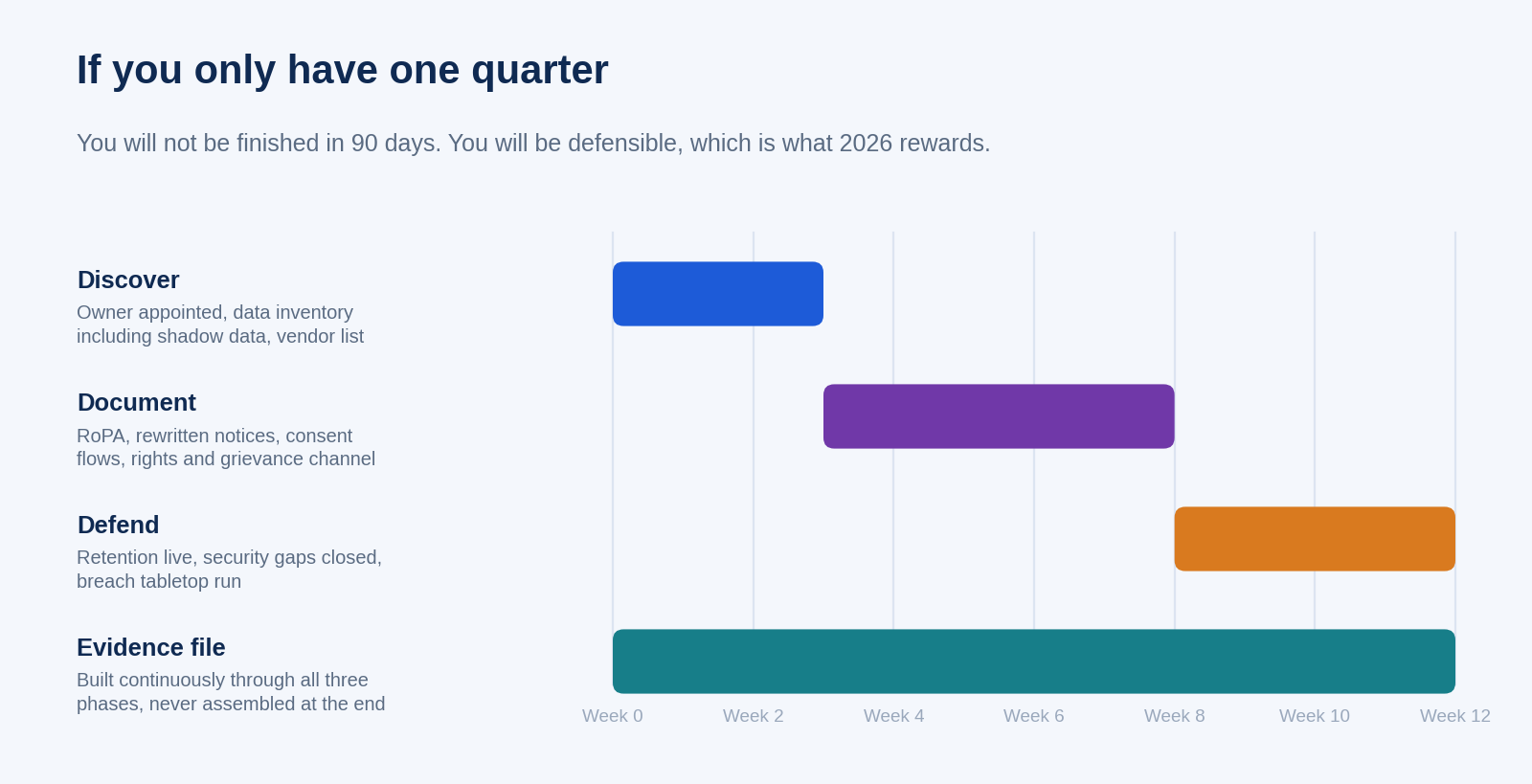
You will not be finished at the end of it. You will be defensible, which in 2026 is the thing that actually matters.
Five findings that show up again and again
| The finding | Why it happens | The fix |
|---|---|---|
| A policy on the website with nothing behind it | Someone bought a template. Nobody built the machinery. | Do Steps 1 to 3 before touching the policy again |
| Consent that was never really consent | Pre-ticked boxes, bundled permissions, dead withdrawal links | Rewrite the collection point, then re-consent legacy records |
| “We're only a processor” | True for client data, false for your own staff and website | Map employee, applicant and visitor data as your own |
| Employee data treated as out of scope | Internal gets mistaken for exempt | Add HRMS, biometrics, CCTV and payroll to the RoPA |
| Waiting for a designation before starting | Significant Data Fiduciary status feels like someone else's problem | If you might be designated, your 12-month clock starts on that day, not before |
The desk test: twelve questions to answer today
Answer these honestly. Every “no” is a task, not a crisis.
| # | Question | A “no” means |
|---|---|---|
| 1 | Can you name the one person accountable for DPDP here? | Start at Step 1 |
| 2 | Do you have a current list of every system holding personal data? | Start at Step 2 |
| 3 | Do you know which of those systems hold children's data? | Step 2, urgently |
| 4 | Can you show, for one named customer, what you hold and why? | Step 3 |
| 5 | Can you prove what that customer consented to, and when? | Step 4 |
| 6 | If they asked you to delete everything today, could you? | Steps 5 and 6 |
| 7 | Is your grievance contact published where a person would find it? | Step 1 and Step 5 |
| 8 | Do you have signed data protection terms with your top ten vendors? | Step 7 |
| 9 | Do you know which vendors send data outside India? | Steps 3 and 7 |
| 10 | Does every data category have a retention period that is enforced? | Step 6 |
| 11 | Could you file a detailed breach report within 72 hours, starting tonight? | Step 9 |
| 12 | Is your evidence in one place, dated, and current? | Step 10 |
Ten or more “yes” answers means you are ahead of most Indian organisations. Fewer than five means you have a productive quarter ahead of you, not an emergency.
The honest closing thought
DPDP readiness is far less intimidating than the commentary around it suggests. It rewards ordinary organizational discipline: knowing what you hold, knowing why, keeping promises to the people whose data it is, and writing it down as you go.
The organizations that will struggle in 2027 are not the ones with small budgets. They are the ones that kept waiting for perfect clarity before taking the first step. Clarity arrives through the work, not before it.
Start with Step 2 this week. Find your data. Everything else follows from knowing what you actually have.
ABOUT VAULTDEF
Vaultdef turns this checklist into a working programme: automated data discovery and classification, RoPA and data mapping, consent and notice management, data principal rights, breach workflow, DPIA, vendor and cross-border tracking, cookie consent, and a tamper-evident evidence trail built for the day someone says “prove it.”
Request a walkthrough at vaultdef.com
Frequently asked questions
Does the DPDP Act apply to small companies?
Yes. There is no turnover or headcount threshold. If you process digital personal data, you are a Data Fiduciary. Certain classes of organisations get relaxations on specific obligations, but the core duties apply broadly.
When is the DPDP compliance deadline?
The DPDP Rules, 2025 were notified on 13 November 2025 with phased commencement. Consent Manager provisions apply from 13 November 2026, and the substantive obligations from 13 May 2027. A proposal to compress the window for Significant Data Fiduciaries has been discussed but not notified.
Do we need a Data Protection Officer?
A DPO based in India is mandatory for Significant Data Fiduciaries. Every other organisation should still appoint an internal privacy lead and publish a contact point for grievances.
Is a DPDP audit mandatory for everyone?
The annual DPIA and independent audit requirement applies to Significant Data Fiduciaries. Every other organisation should run internal reviews, because a documented review programme is what you rely on if the Board ever examines your conduct.
Does DPDP compliance cover employee data?
Yes. Employees, applicants, contractors and visitors are all Data Principals. HR records, biometric attendance and CCTV footage are all in scope.
Can we achieve DPDP compliance using software alone?
No. Software handles discovery, consent records, rights requests, retention and evidence at scale. Ownership, policy decisions, vendor contracts and staff behaviour remain human work. Process first, tooling to sustain it.